
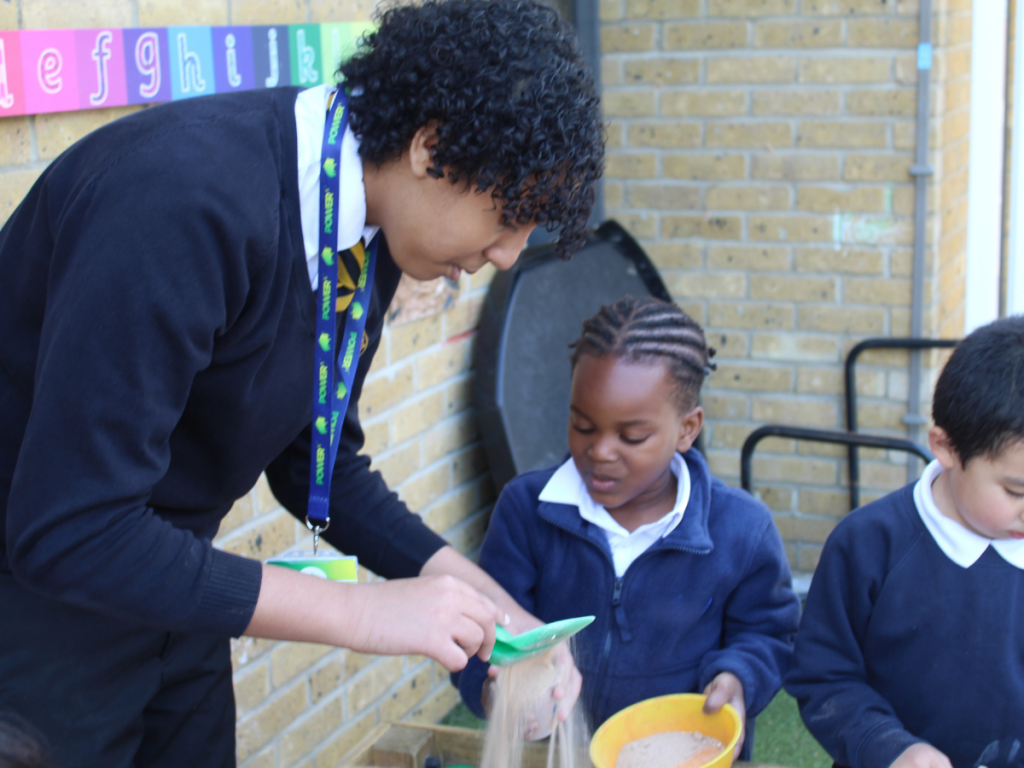
A unique kind of learning experience
Power2 Thrive provides a tailored experience for secondary-school students. The 16-week programme takes them out of their usual school environment and into a nursery setting, where they spend a morning or afternoon a week mentoring a younger child. In doing so, they form meaningful friendships with their mentees while actively supporting their learning and development.
The programme replicates our award-winning Teens and Toddlers model but with added support for young people’s wellbeing.
Evaluation findings
The evaluation looked at programme data from over 600 young people, alongside interviews, observations and teacher assessments across three schools. We set out to explore who the programme works for, what elements create change and whether we’re measuring the right things.
The greatest and most meaningful improvements were found in young people’s personal and emotional development. Of the young people we have supported:
- 83% improved their confidence
- 82% improved their communication
- 80% improved their self-esteem
- 70% improved their attitude towards education
The findings also suggest that the programme may be particularly valuable for young people starting with the greatest wellbeing need.
But why does Power2 Thrive work?
Young people who are experiencing challenges are often put into boxes about what they can achieve. Opportunities to become prefects or house seniors are usually reserved for those with excellent attendance, positive behaviour points and stereotypically ‘model’ students.
A young person who might struggle to concentrate in lessons, find it difficult to communicate or whose anxiety impacts their school attendance isn’t normally the first in line to be trusted in positions of responsibility.
Our group mentoring model takes a unique approach, and the evaluation points to three interconnected elements critical to the programme’s success.
- A genuine safe space. Facilitators build trusting, non-judgemental relationships with young people, creating a space that feels different from their usual school environment. It gives young people the confidence to open up, try new behaviours and shed the defensive habits they may carry into lessons.
- A transformative role. Young people take on real professional responsibility – wearing a Power2 lanyard, supporting toddlers, and working towards a formal qualification. For many, this is the first time they have been trusted with a meaningful role in a way most won’t have experienced before.
- A built-in learning loop. Skills taught in the group classroom sessions – communication, emotional regulation, active listening – are immediately practised in the nursery setting, so young people can internalise and apply them in real situations, not just learn them in theory.
These elements of Power2 Thrive give young people the opportunity to develop a “new sense of self” and the supportive space to test it out.
As one teacher told evaluators, “Those with low self-esteem don’t think they’re good at anything – this programme is great for showing them they have skills they didn’t recognise they had.”
This is particularly encouraging as it supports the thinking behind the model that young people need opportunities to experience themselves differently through trusted relationships, meaningful responsibility and the chance to learn by doing.
How we’re refining what works
The evaluation also identified some practical ways we can strengthen the programme and ensure that young people consistently get the best possible experience.
Reducing the school-like feel of the workbook
We received feedback that there is too much writing in the Power2 Thrive workbooks young people complete as part of the programme. We introduced the programme in 2023 and since then we’ve been working with our Youth Network to change the design of our workbooks to an ‘activity book’ style, which includes less writing and more conversational activities and quizzes whilst still delivering all of the learning objectives needed for young people to achieve their Level 1 qualification. Four of our other programmes have been designed in this new look and feel already and we’ll be working with our Youth Network to refresh the Power2 Thrive workbook too.
Formalising the feedback received from nurseries
Early-years teachers see young people in a completely different environment from their secondary school, which offers them a new perspective on their strengths, confidence and skills. For young people who may have become used to being seen in a particular way at school, it can be transformative. Feedback from nurseries is currently received on an ad hoc basis, but we plan to create a formalised process to include the programme’s impact on the nursery children, positive behaviours teachers have noticed in our young mentors and thoughts on how the programme could be improved.
What did the evaluation challenge us to think about?
A key part of the evaluation was to understand whether our monitoring methods were measuring the right things. The analysis suggests that although the Warwick Edinburgh Mental Wellbeing Scale (WEMWBS) is robust and aligns across the rest of our suite of programmes, it risks underselling the programme’s true impact.
Both the quantitative and qualitative evidence the evaluators reviewed consistently point to strong improvements in confidence and self-efficacy; young people said they felt they were capable of things they couldn’t previously do.
WEMWBS measures wellbeing, but it was never designed to isolate and measure self-efficacy – even though we know the two are interlinked. As a result, Stories of Change recommends that we use the New General Self-Efficacy Scale (NGSE) alongside WEMWBS to measure improvements in self-efficacy.
The NGSE has been validated with young people from low-income backgrounds who closely mirror the young people we support and produces a focused general self-efficacy score that tells a complementary story to WEMWBS.
We have already embedded the NGSE across all our programmes from September, and will report back on what we find at the end of this academic year.
Summary
The evaluations give us confidence in the effectiveness of Power2 Thrive. It confirms that it is valued by young people, their families and teachers, with particularly strong evidence of impact on confidence, communication and self-esteem.
It also gives us a clearer picture of how to improve the programme: protecting the elements of the programme design that make Power2 Thrive distinctive and refining the programme around what young people tell us works best for them.
We’d like to say a huge thank you to Stories of Change for working with us on the evaluation of the programme. Thank you to all the funders who have enabled us to deliver Power2 Thrive, with special thanks to the Prudence Trust for funding the evaluation.
Building young people’s confidence
Would you like to give young people in your school or locality the opportunity to experience themselves differently? We’d love to hear from you!


