Introduction
Power2 abides by the duty of care to safeguard and promote the welfare of children and young people and is committed to safeguarding practice that reflects statutory responsibilities, government guidance and complies with best practice requirements. Successful outcomes for children and young people depend on strong multi-agency partnership working across the whole system of care, support and protection. Power2 is one part of the system and where appropriate defers concerns to schools, the Lead Safeguarding Partner or the Delegated Safeguarding Partner.
Everyone working with participants should be familiar with these procedures and have a duty to report any concern to the nominated safeguarding officers. Failure to follow it will be dealt with as a very serious matter.
Aims and objectives
To ensure the wellbeing and safety of all participants who take part in Power2 programmes and activities. To ensure staff and volunteers know how to keep children and young people safe and ensure their wellbeing. To outline the protocols for all Power2 programmes.
All Power2 trustees, staff, associates, third party providers and volunteers have a duty of care to safeguard and promote the welfare of all participants of Power2 programmes.
Designated safeguarding lead
The Designated Safeguarding Lead (DSL) at Power2 is a senior member of staff and they are the primary contact for staff reporting concerns, liaising with other agencies, managing records and identifying and delivering training. Power2 also has two deputies in place to support the DSL, be a contact for staff reporting concerns and assist with training. The DSL team undertakes additional training with refreshers held every three years.
The contact details for the DSL team are:
| Name | Role | Mobile |
| Sam Marcus | Designated Safeguarding Lead | 07715 901 260 |
| Jennifer Smith | Deputy Safeguarding Lead | 07562 616 180 |
| Suzanne Kennedy | Deputy Safeguarding Lead | 07715 901 263 |
Policy statement
Power2 believes that:
- It is always unacceptable for anyone to experience abuse of any kind. We recognise our responsibility to safeguard all children and young people and promote their welfare. We will do this by creating a safe environment within which they can thrive and Power2 staff, volunteers and other representatives can work with the security of clear guidance.
- The welfare of the child and young person should always be the paramount consideration.
- All children and young people, regardless of age, disability, gender, ethnicity, religion, sexual orientation, language or social background have the right to equal protection from all types of harm or abuse.
- Safeguarding and responding to child protection concerns is the responsibility of all staff, volunteers and representatives whether salaried or voluntary, whatever their role or status.
- Promoting the welfare of children by working in partnership with them, their parents, carers and other agencies is essential.
Power2 ensures that:
- Statutory requirements concerning Disclosure and Barring Service checks are met,
- Up-to-date safeguarding policy and procedures are maintained.
- Legal frameworks and procedures for dealing with safeguarding concerns are the fundamental principles applied wherever we are working.
- Safeguarding training to all staff and volunteers is provided. This training is informed by wider guidance, best practice and industry experts.
Power2 will seek to safeguard children and young people by:
- Valuing, listening to and respecting them.
- Through our work, supporting them to develop an awareness of unacceptable behaviour and what they can do about it.
- Providing a safe space to explore, discuss and debate a range of social and political issues in a rapidly changing world.
- Recruiting employees and representatives safely, ensuring that all necessary checks are made.
- Recording and storing information professionally and securely.
- Sharing information about safeguarding protection and good practice with employees, volunteers and other representatives.
- Using our safeguarding procedures to share concerns and relevant information with authorised agencies who need to know and who will manage it and respond appropriately (e.g. schools and social workers).
- Appointing a Designated Safeguarding Officer.
- Appointing a board member as Trustee Safeguarding Lead to have oversight of our safeguarding work.
- Adopting safeguarding and child protection practices through robust policies and procedures.
- Undertake a biannual self-assessment audit of our safeguarding practices.
All Power2 staff and volunteers will:
- Be able to identify potential indicators of abuse, neglect or radicalisation.
- Have read the safeguarding policy.
- Know their role and responsibilities in their team.
- Know how to communicate and record concerns.
- Know to act upon concerns in line with the principles and procedures for child protection management and working together to safeguard children.
Therefore, all children and young people in contact with Power2 will:
- Be treated with respect and afforded full civil and legal rights.
- Be listened to and taken seriously, whatever their level of development or communication.
- Be given time to do things for themselves, to understand and be understood.
- Be involved in decisions that affect them.
- Have their privacy always respected and in all places.
- Have a right to confidentiality – all information about them will be treated carefully, be kept safe and only shared with those people who need to know (e.g. schools and social workers).
The wellbeing of participants is the paramount consideration in all circumstances.
Definitions
Safeguarding can be defined as:
- Providing help and support to meet the needs of children and young people as soon as problems arise.
- Protecting children and young people from maltreatment, whether that is within or outside the home, including online.
- Preventing the impairment of children’s and young people’s mental and physical health or development.
- Ensuring that children and young people grow up in circumstances consistent with the provision of safe and effective care.
- Taking action to enable all children to have the best outcomes.
Child protection: Refers to the actions taken to protect children who are at immediate risk of harm.
Child: Although we recognise that the legal definition of a child varies in different countries, for the purpose of this policy children are defined as all those under 18 years of age.
Young person: For the purposes of this policy a young person is anyone aged between 18 and 25.
At risk adult: For the purposes of this policy an at risk adult is someone over the age of 18. An at risk adult is an individual who has needs for care and support, who is experiencing, or at risk of, abuse or neglect and as a result of their care needs is unable to protect themselves.
Participants: For the purposes of this policy the reference to participants will include children and young people that have taken part in a Power2 programme.
Loco parentis: Latin for “in the place of a parent” and refers to the legal responsibility of a person or organisation to take on some of the functions and responsibilities of a parent. It allows colleges and schools to act in the best interest of the students as they see fit, although not allowing what would be considered violations of the students’ civil liberties.
Types of safeguarding harm
Abuse: Child abuse, sometimes also referred to as ‘maltreatment’, is defined as all forms of physical and/or emotional ill-treatment, impact of witnessing ill treatment of others, sexual abuse, neglect, radicalisation, misuse of power, coercion or control over another person, commercial or other exploitation resulting in actual or potential harm to the child’s health, development or dignity. Abuse is harm which is so severe or persistent that it is deemed “significant” and is likely to have a lasting effect on the health or development of the child. This policy applies to all forms of harm, including harm which may be caused intentionally or unintentionally, and which may not reach the threshold of significant harm.
Physical abuse: May involve injury by biting, hitting, shaking, throwing, poisoning, burning or scalding, drowning, suffocating or otherwise causing physical harm to a child or young person. It also includes giving children alcohol, inappropriate drugs and fabrication of an illness or deliberately inducing an illness.
Emotional/psychological abuse: Where there is a persistent lack of love and affection that damages children emotionally e.g. being constantly shouted at, seeing or hearing another person being harmed (as in domestic violence or parental substance misuse), threatened or taunted including serious bullying and conveying that a child is worthless or unloved, inadequate or only valued in so far as they meet the needs of another person.
Sexual abuse: Where adults use children to meet their own sexual needs. This may include full intercourse or fondling, showing children pornography and using sexualised language.
Neglect: Where the responsible adult fails to adequately provide for a child’s basic need, for example clothing or food, being left unsupervised and alone, failing or refusing to give children their love and affection and providing access to appropriate medical care or treatment.
Online abuse: Any type of abuse that happens on the internet. It can happen across any device that’s connected to the web and can happen anywhere online, including: social media, messaging apps, emails, online chats, online games and live streaming sites. Children can be at risk of online abuse from people they know or from strangers. The abuse could be happening online only or as part of other abuse taking place offline.
Child-on-child abuse: Children can abuse other children. This is generally referred to as child-on-child abuse (formally peer-on-peer abuse) and can take many forms. This can include (but is not limited to) bullying (including cyberbullying); sexual violence and sexual harassment; physical abuse such as hitting, kicking, shaking, biting, hair pulling, or otherwise causing physical harm; sexting and initiating/hazing type violence and rituals.
Radicalisation: The process by which a person comes to support terrorism and extremist ideologies associated with terrorist groups. Individuals can be drawn into the process of radicalisation in several ways including individuals who, because of their circumstance, experiences or state of mind can be led towards an extremist ideology. If you have a concern:
- Notice something of concern.
- Check your concern with someone who can put it into context.
- Share your concern with the best person to take this forward.
Organisational abuse: Specifically relevant to safeguarding young person. This includes neglect and poor care practice in an institution or specific care setting, such as a hospital or care home, or in relation to care provided in one’s own home. Organisational abuse can range from one off incidents to ongoing ill-treatment. It can be through neglect or poor professional practice as a result of the structure, policies, processes and practices in an organisation.
Financial or material abuse: Specifically relevant to safeguarding a young person. This includes theft, fraud, internet scamming, and coercion in relation to a young person’s financial affairs or arrangements, including in connection with wills, property, inheritance or financial transactions. It can also include the misuse or misappropriation of property, possessions, or benefits.
Domestic abuse: This includes psychological, physical, sexual, financial, impact of witnessing ill treatment of others and emotional abuse perpetrated by anyone within a person’s family. It also includes so-called “honour” based violence.
Self-neglect: Specifically relevant to safeguarding a young person. This covers a wide range of behaviour, but it can be broadly defined as neglecting to care for one’s personal hygiene, health, or surroundings. An example of self-neglect is behaviour such as hoarding.
Modern slavery: This encompasses slavery, human trafficking, forced labour, and domestic servitude.
Discriminatory abuse: Discrimination is abuse that centres on a difference or perceived difference, particularly with respect to race, gender, disability, or any of the protected characteristics of the Equality Act.
Underpinning guidance
- The welfare of the child or young person is paramount, as enshrined in the Children Act 2018.
- All children and young people, regardless of age, disability, gender, ethnicity, religion, sexual orientation, language or social background have a right to equal protection from all types of harm or abuse.
- Some children and young people are additionally vulnerable because of the impact of previous experiences, their level of dependency, communication needs or other issues.
- Working in partnership with children, young people, their parents, carers and other agencies is essential in promoting mental health and welfare.
- Power2 will align with the DfE Keeping Children Safe in Education guidance document wherever appropriate.
Protocols
All our safeguarding cases (in school environments) are deferred to schools because they are ‘in loco parentis’ of the students. A shared responsibility for safeguarding involves multi-agency partnerships and working with parents and carers. Our delivery team often has strong and trusting relationships with parents, but we will continue with the in loco parentis approach of working through schools or other appropriate bodies. The Programme Lead will follow up on all safeguarding forms with the appropriate safeguarding lead and only close a case in consultation with them and the Power2 Designated Safeguarding Lead. The Designated Safeguarding Lead will be updated regularly whilst a case is open.
Safeguarding concerns will also be discussed at the programme debrief with the school. Should there be any new information this will be added to the original safeguarding form.
As Power2 delivers different programmes in multiple locations we have identified general protocols that must be followed for each programme and specific guidance for each type of programme run: In School Setting, Online/Virtual and with other programmes. For example all delivery staff must have the NHS Safeguarding App available on their work phones. This app is both a safeguarding resource with useful information and legislation along with the contact details for every Local Authority.
Currently, Power2 does not work with at risk adults. If this were to change the Designated Safeguarding Lead and relevant delivery staff will undergo the appropriate training and general information and principles will be rolled out to the rest of the organisation.
General
- Consent forms are completed for all participants on all programmes.
- Safeguarding sheet shared with programme participants.
- Participants are given the mobile number of delivery staff (for emergencies, not attending a session, support etc) at the start of programmes. Participants will be informed that this number is only in use during working hours; outside of these hours’ they should refer to the provided safeguarding sheet.
- Programme Leads hold responsibility for the safety and welfare of their groups. Programme Assistants must report any concerns to the Programme Lead who will then provide support in completing the safeguarding form and any follow up.
- All Power2 equipment is password protected and settings configured to turn off/lock after five minutes of inactivity.
- When participants use Power2 equipment to access the internet they must be supervised. Following any activity the browser history must be checked and any concerns reported by following the standard safeguarding reporting procedure.
- Visitors to our projects will always be accompanied by a member of the Power2 team.
- Always refer to our safeguarding disclosure plan to ensure a consistent approach to reporting when we have concerns about a child or young person.
- The safeguarding form (see Appendix 1) is password protected before it is shared.
- Share concerns with agencies who need to know and involve parents, children appropriately. If the concern is about a child in school, the school holds loco parentis.
- Share concerns (appropriately and when necessary) about potential PR risks and manage these risks in line with our communications guidelines and safety measures.
- Ensure contact details are current and available for the Designated Safeguarding Lead and Advisors, the school contact and useful contact numbers (Appendix 2), to enable signposting for participants e.g., ChildLine.
- Briefing and necessary consent is obtained from parents/guardians, schools, nurseries, stakeholders and local authorities (as appropriate) ahead of any media/press/PR activity as well as providing practical information, advice and guidance on media interviews to children and young people and stakeholders.
- Quality assurance to be carried out on projects to ensure relevant training is identified for staff to ensure we uphold safeguarding procedures.
- Run check-out at end of session to ensure participants have had the chance to raise any issues or concerns.
Ensuring young children’s safety
Safeguarding children in the nursery is paramount. To further support nursery children’s safety we ensure:
- The Eligibility Criteria form is signed off by the Designated Safeguarding Lead at the secondary school to ensure at risk students aren’t referred to programmes involving younger children.
- A risk assessment is completed for each programme.
- A dedicated session is held with the teenagers prior to attending the nursery school to ensure they know their role and how they need to behave with the younger children. The teenagers are taught about safeguarding and confidentiality – See appendix 4.
- A member of school staff will talk to the teenagers about expectations and safeguarding during the first visit to the nursery or primary school.
- A check in is carried out before each nursey or primary session to ensure the teenagers are in the right frame of mind to work with younger children.
- A debrief with the teenagers is held after each nursery or primary session to ensure there were no issues that need to be addressed.
In school setting
- All staff working in a school setting are expected to know the Safeguarding Lead and the school’s protocol for managing child-on-child abuse. The Power2 safeguarding form will be used to record all instances.
- No child or young person can leave the secondary school premises without a signed parental consent in place.
- Ensure ‘project risk assessment’ (see Appendix 5) is completed for each project venue, to include travel considerations.
- Group number and staff ratios: 8-12cyp = 2 staff members.
- Provide secondary school with register of students taken off site.
- Ensure all staff have contact sheet with medical notes and emergency contact details.
- When working with children and young people in an alternative provision setting any safeguarding concerns will be reported to the alternative provision and the child or young person’s mainstream school, as they retain safeguarding responsibility.
Lone working
Ordinarily, working alone with a child or young person is not standard practice; however, we acknowledge that there are times when this could occur. When the lone working occurs in a virtual setting the protocols outlined below must be followed.
For face-to-face lone working staff should ensure that they meet with the child or young person in a public place or where they can be viewed from the outside. Power2 will supply all delivery staff with a Work Smart, Work Safe guidance document. This document provides pointers on how to maintain professionalism in the face of abuse and what to do. Power2 will ensure that the protocols set out in this policy are understood and followed. Power2 will ensure that appropriate arrangements are in place to identify the whereabouts of staff, volunteers and secondees whilst on Power2 business, including the programmes being delivered. No member of staff, secondees or volunteers should ever undertake home visits without first consulting with their line manager or designated Safeguarding Lead.
Online/virtual
All virtual sessions carried out over Zoom/Teams will:
- All content to be posted through Power2 accounts only unless prior agreement and arrangement from the Director of Services.
- Have passwords for all participants.
- Have waiting rooms enabled (where participants must confirm their identity or where that is not possible alternative arrangements will be agreed with Power2 staff).
- Staff to be aware of their clothing and background. Ensuring they are dressed appropriately and there are no images or sounds that could cause offence or upset.
- Participants will agree to the virtual guidelines (see Appendix 6) prior to the session as this obtains consent for sessions to be recorded.
- For group sessions always have a minimum of two members of staff in attendance.
- All sessions will be recorded.
- Ensure all participants must sign-up for the session in advance and a register will also be taken.
- All content should be appropriate for all participants.
- If there is any inappropriate behaviour/remarks the individual will be removed from the session.
- Communications with children and young people through personal social media accounts is strictly forbidden (for the purposes of this policy LinkedIn is not considered a social media channel because of the benefits of professional networking).
- If a child or young person contacts a member of staff, comments or shares a response that is a concern, the member of staff must raise it with the safeguarding team immediately.
- Virtual invitations must not be shared with any person that is not known to Power2 without prior approval from the meeting organiser.
Other programmes
- The safeguarding disclosure plan remains consistent for all participants who are in school, i.e. duty of care remains with the school. If the child or young person (CYP) is not in school, then escalation is through their borough’s social services department and/or local police unit.
- Young people (18-25 years old only) must give consent before a disclosure can be dealt with. If they choose not to report the concern, staff should log and note on the report that the person wishes for no further action to be taken. However, if the individual is an at risk adult or in immediate danger consent is not needed.
- Ensure that up to date emergency contact details and any medical notes are held for all participants and securely saved on Salesforce.
- Ensure external trainers have a current DBS (responsibility lies with programme managers).
- Group number & staff ratios: 8cyp – 1 staff member for internal events and 5cyp to 1 staff member if leaving the main office. We will endeavour to have two members of staff available whenever there are two or more children or young people present.
- All participants will sign their understanding and acceptance of a ‘Code of Engagement’ (see Appendix 7).
- When working with volunteers, including mentors:
- An up-to-date DBS check is required.
- Safeguarding to be included in the induction training.
- All meetings to be held in public places.
- All concerns to be raised with the Programme Manager.
Training
All staff (including senior management and nominated trustees) will have training (NSPCC: Introduction to Child Protection) so they know how to look after the wellbeing and safety of children and young people. New starters will be encouraged to complete the safeguarding training on their first day with Power2. Basic safeguarding training is also included in the programme facilitator on-boarding training. Volunteers not involved in regulated activity, having access to children or young people or to confidential data will be required to complete a level 1 introduction to safeguarding course.
At the core of our support is an understanding of how Adverse Childhood Experiences (ACEs) can cause trauma and how aggressive/disruptive behaviours, dis-engagement, withdrawal, school refusal, etc. are a means of communication. To support this all our delivery staff (including the Senior Management Team) complete an introduction to ACEs early trauma e-course provided by the Home Office Early Intervention Fund.
Staff working with young people are also required to complete young adult safeguarding training provided by the NSPCC.
In addition to this standard training all front-line delivery staff will also undertake addition training as necessary, for example, PREVENT agenda, online safety and recognising and preventing female genital mutilation. A record of all additional training recommended and completed is held centrally. Additional training will be identified from legislation and guidance changes, NSPCC advice, staff identified, and issues known to a specific area.
In addition to training Power2 provides effective management for staff and volunteers through supervision and support.
Safeguarding updates and refreshers are covered by the regular staff bulletins and at least annually will include scenario practice and updates on policy and procedures.
Safeguarding disclosure plan
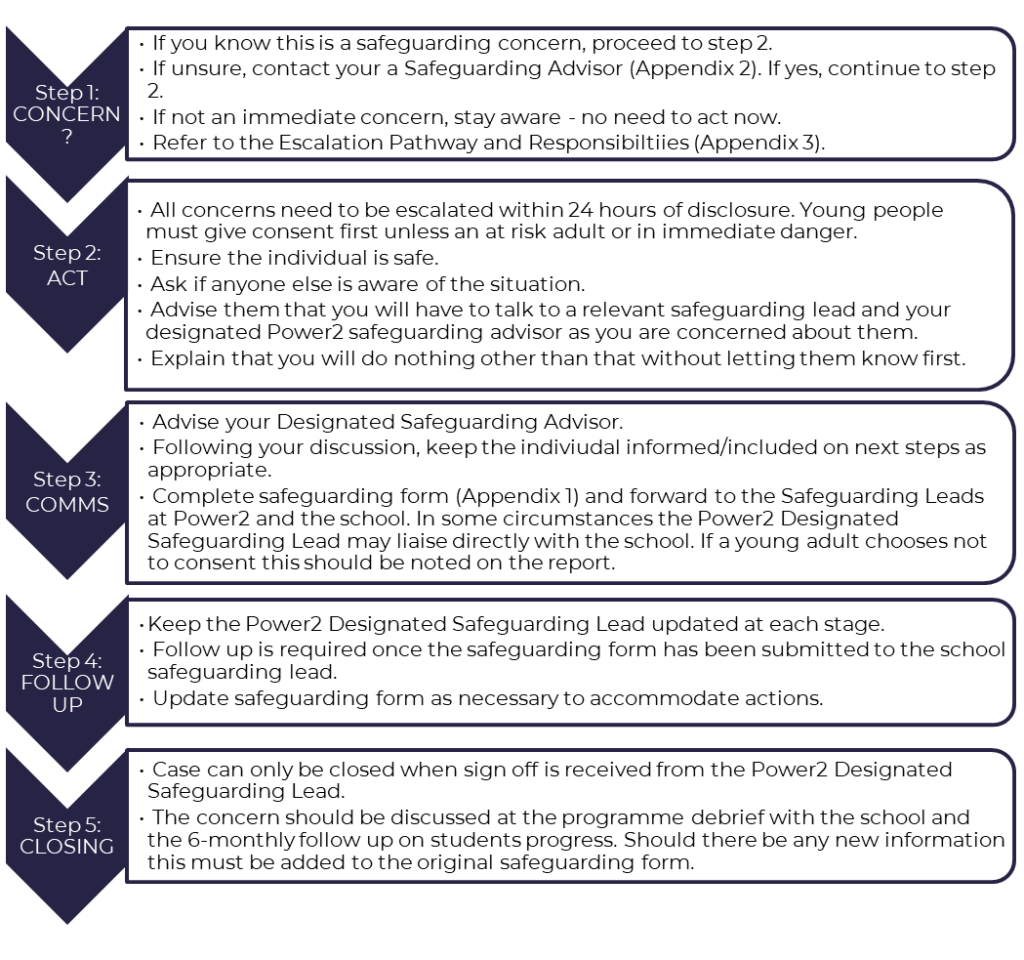
Details on how to handle a concern can be found in Appendix 8 and Appendix 9 contains the staff poster that is displayed throughout our offices and provides a simplified version of the safeguarding disclosure plan.
In order to support any potential future proceedings we will always consider if it is appropriate for the disclosure to be recorded, with consent (for the recording), and for notes to be taken during the disclosure to ensure that the terminology used by the child or young person is captured accurately.
Allegations against staff
Where it is alleged that any person working for or volunteering with Power2 has:
- Behaved in a way that has harmed a child, may have harmed a child, or might lead to a child being harmed.
- Possibly committed or is planning to commit a criminal offence against a child or related to a child.
- Behaved towards a child or young person in a way that indicates s/he is or would be unsuitable to work with children.
This applies if the allegation is about a current incident or has occurred historically.
The allegation can be about any child, for example a child:
- In receipt of a Power2 programme.
- Involved in a fundraising or participation activity.
- Not known to Power2.
- That a member of staff or volunteer has contact with in their community/home life.
- Is the son or daughter or family member of the employee or volunteer.
The allegation may:
- Not directly identify a known child victim. For example, if a staff member or volunteer is accessing abusive images of children online or using the internet to groom children with the intent to harm in future.
- Be about any type of abuse – physical, emotional, sexual or neglect.
- Concern a breach of Power2’s safeguarding policy and code of conduct on appropriate professional conduct.
- Relate to Power2 staff and volunteers who have behaved in a way that may have harmed an at risk adult.
Allegations of abuse that come to Power2’s attention more than twelve months after the initial allegation being made are regarded as ‘non-recent’ abuse, also known as historic abuse.
If an allegation is made
If a child is at risk of immediate harm or needs emergency medical attention, the emergency services must be contacted, and the parents/carers informed that immediate steps are being taken to get help. If the allegation does not relate to a Power2 employee or volunteer (eg. the allegation is against a child or young person), all actions taken should follow the “safeguarding disclosure plan”.
When the allegation relates to a Power2 employee or volunteer, the person who receives the allegation must make a note of the basic details of the allegation, to include the:
- Name of the individual who the allegation is about and any other identifying information, including location.
- Name of any children involved.
- Date and time of the allegation arising.
- Name and contact details of the person making the allegation.
- Key information about the nature of the safeguarding allegation.
The person should then inform the Designated Safeguarding Lead and agree next steps to safeguard a child/ren. If the concern is about the Designated Safeguarding Lead then the person should inform the CEO.
If the allegation involves a specifically named child, the Designated Safeguarding Lead will ensure a search of all Power2 records is completed, to ascertain whether any records need to be secured or any equipment removed from the individual. Where records are identified, the following process will be followed:
- Where a record relates to an open case, the Designated Safeguarding Lead will action the case to be secured on the relevant recording system, so that previous records cannot be altered, but new information can be added.
- Where a record relates to a closed case (not archived), the Designated Safeguarding Lead will ensure the case is secured so details cannot be altered.
- All records will remain secure for the duration of the process of managing an allegation.
There may be up to four strands when considering any child protection concern or allegation against a staff member or volunteer, as follows:
- Enquiries and assessment by children’s social care about whether a child needs protection and/or services.
- A police investigation of a possible criminal offence.
- Consideration by Power2 of suspension/disciplinary action in respect of the individual. Volunteers will be suspended from any role with the charity.
- Referral for ‘consideration to bar’ a person from working with children (for example, referral to the Disclosure and Barring Service (or equivalent) and/or referral to a professional registration body for professional misconduct).
Procedure for managing a safeguarding allegation
The Designated Safeguarding Lead will oversee the coordination and management of all allegations and must be notified of every allegation. They will have oversight of the investigative strategy and process and the reporting mechanisms to be adopted and will agree who the investigating manager is. The investigative task and responsibilities will be delegated to an investigating manager unless there are exceptional circumstances, for example where there is a conflict of interest.
If the Designated Safeguarding Lead confirms the information as a safeguarding allegation, an initial plan will be agreed with the investigating manager, CEO and at least one of the Deputy Safeguarding Leads within 24 hours. If after the initial assessment the Designated Safeguarding Lead does not consider the matter constitutes a safeguarding allegation, then they must decide in consultation with the relevant managers if an internal investigation is required to determine if the behaviour/incident was related to poor practice or misconduct in which case the disciplinary policy will be instigated by the line manager. All decisions and the reasons for them must be recorded.
In some cases, Power2 will decide to suspend the employee who is the subject of the allegation or cease to use the services of a volunteer on a temporary basis. The act of suspension does not indicate a person’s guilt, it is a neutral act. An individual must not be suspended automatically when there has been an allegation or without careful thought.
Suspension should be considered in any case where:
- There is reason to suspect a child is at risk of significant harm and the allegation warrants investigation by the police.
- The allegation is so serious that if substantiated it might be grounds for dismissal.
- There are concerns that the person about whom the allegations are made may put pressure on or interfere with potential witnesses.
- The person by carrying out their normal duties may pose a risk to others and this risk cannot be reasonably mitigated against through increased supervision or a temporary change of duties.
The power to suspend a member of staff or volunteer because of an allegation is entrusted to Power2 alone. In making this decision the investigating manager in conjunction with the CEO may need to take into consideration the views of the police and the Designated Officer for the LA, if relevant.
The investigating manager, in consultation with the Designated Safeguarding Lead and CEO, will be responsible for deciding how and when to feedback to the person who made or received the allegation, and what information to give to relevant others who may know the accused individual concerned.
Recruitment & induction process
This section should be read in conjunction with Power2’s Safer Recruitment and Selection Policy and Equality, Diversity and Inclusion Policy.
Safeguarding is central in our recruitment process and includes the following measures:
- Recruitment of new staff, trainees and volunteers is competency based, to support an integrated understanding of experience and reliability in working with vulnerable people.
- As part of the recruitment process Power2 may decide to conduct an online search prior to interview to help identify any incidents or issues that have happened are publicly available online.
- Recruiting safely by carrying out thorough checks on potential employees which will include at least 2 references and a DBS check.
- Keeping records of all DBS checks including date of issue and date of renewal and ensuring DBS certificates are not more than 3 years old.
- All successful candidates will receive a formal induction process, to assist new starters to more fully understand how their role links with the overall business of the charity. As part of the induction process, candidates will undergo and complete:
- A criminal records check under the Disclosure and Barring Service (DBS) to ascertain their suitability to work with children.
- Reading and understanding of Power2’s digital and social media policy confirmed by signing the document.
- NSPCC on-line safeguarding training.
- All trustees will be briefed on safeguarding processes as part of their induction and are required to undergo a Disclosure and Barring Service (DBS) check (see Appendix 10 on Trustees’ responsibilities).
- Any volunteer that may have unsupervised access to children will be required to undergo a DBS check prior to working with Power2. A DBS risk assessment will be completed for all volunteers to ascertain if a DBS check is required and what level.
Reporting
The Senior Management Team will receive a safeguarding report quarterly covering concerns, type, outcomes and relevant actions taken (follow up); this will also be sent to the Board member with safeguarding responsibilities and the safeguarding committee. The Board will receive an annual safeguarding report.
Safeguarding will be kept open on the risk register prepared for Trustee Board meetings and be reviewed regularly by the Senior Management Team.
To ensure all staff understand the safeguarding process, regular safeguarding bulletins will be issued to advise of any changes, offer top tips and act as a reminder tool. Safeguarding processes will be tested regularly, and any updates included in the staff bulletin and safeguarding reports.
Review
This policy will be monitored and reviewed every year by the Senior Management Team, Safeguarding Committee and Board of Trustees, or earlier if the legislation changes.
Related policies
| Anti slavery policy | Grievance and disciplinary policy |
| Complaints policy | Whistleblowing policy |
| Staff code of conduct | Health & safety policy |
| Safer recruitment and selection policy | Work smart, work safe guidance |
| Digital and social media policy | Data protection policy |
| Equality, diversity and inclusion policy | Consent policy |
This policy has been drawn up on the basis of law and guidance that seeks to protect children, namely:
| The Children Act 1989 and 2004 | Information Sharing Statutory Guidance 2015 |
| Children and Young Persons Act 2008 | Human Rights Act 1998 |
| Children and Families Act 2014 | Working Together to Safeguard Children 2023 |
| Serious Crime Act 2015 | Prevent Strategy 2011 |
| Counter Terrorism and Security Act 2015 | Sexual Offences Act 2003 |
| Safeguarding Vulnerable Groups Act 2006 | Female Genital mutilation Act 2003 |
| Data Protection Act 2018 | Protection of Freedom Act 2012 |
| United Convention of the Rights of the Child ratified 1991 | Relevant government guidance on safeguarding children |
| Care Act 2014 | Safeguarding Adults Framework |
| Keeping Children Safe in Education 2024 | Achieving Best Evidence in Criminal Proceedings 2022 |
Approval
This policy has been considered and approved by the Senior Management Team, the Safeguarding Committee and Board of Trustees.
Julie Randles
Chief Executive
24 February 2026
Mike Francies
Board Chair
27 March 2026